Murdo Girl…The rhythm of life…The next generation

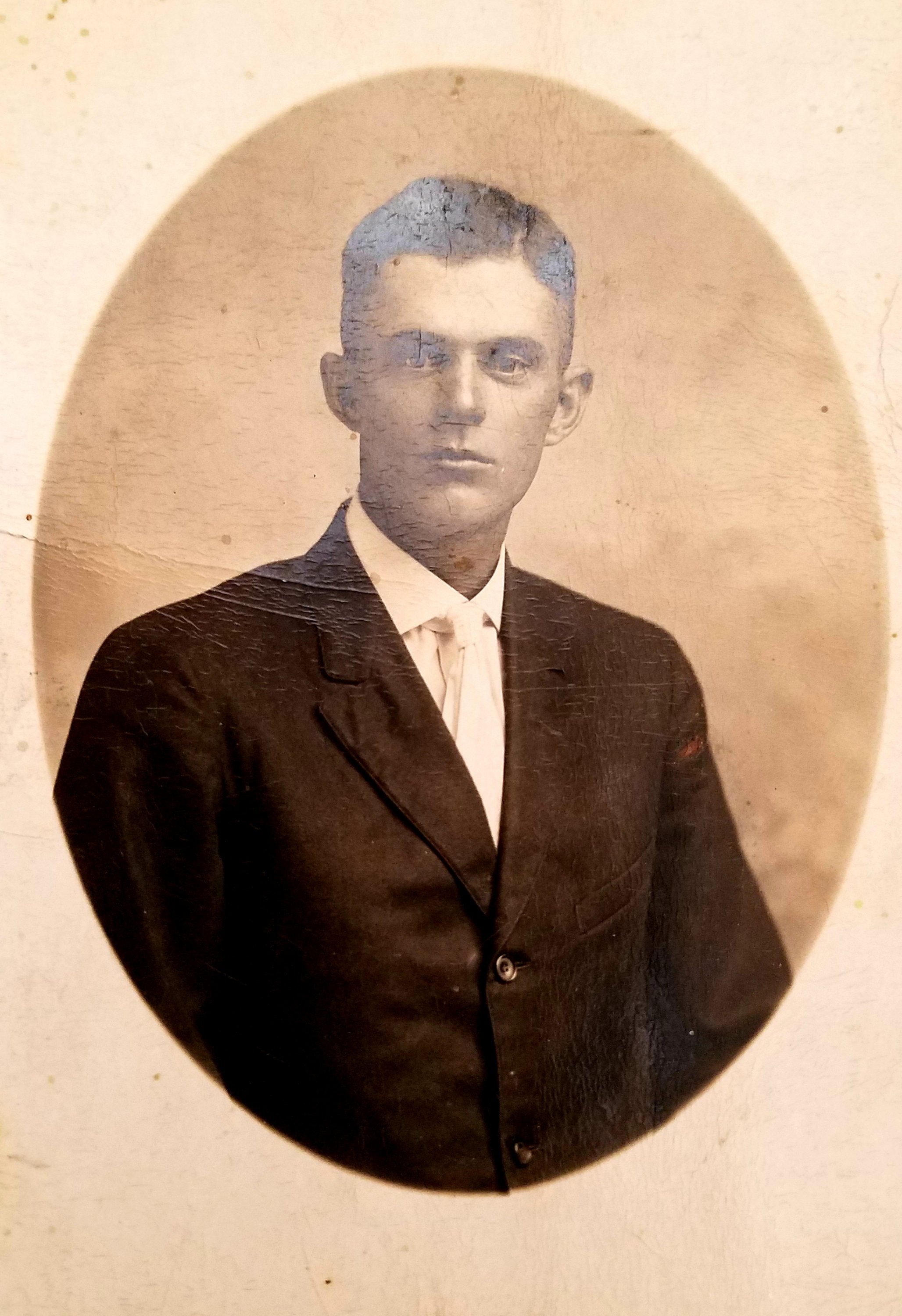
Parnell Marvin Swinson, who went by the name Pete, was born on a farm 15 miles southwest of Presho, SD on December 3rd, 1916. His parents were Peter M. and Mary Christensen Swinson. He was the only son and youngest child of Peter and Mary. He was admittedly spoiled by his 2 older half brothers and four older sisters. Pete didn’t grow up on the homesteads of both of his parents as they moved to Presho before he was 2 years old. They bought a small tract of land in the northeast part of Presho along the Medicine Creek and started a dairy farm so he still had a farm lifestyle with all of the advantages of a small town.

Pete started school when he was five and only tolerated it. His sisters said they had a hard time keeping him warmly dressed in cold weather. He was as apt to start out without a coat or jacket as not. They gave him some credit for bringing home what he wore to school which was in contrast to his good friend Joe Mullen whose trail could be traced by the clothes he left behind. Pete and Joe were good friends and the two of them spent many hours together fishing and swimming.

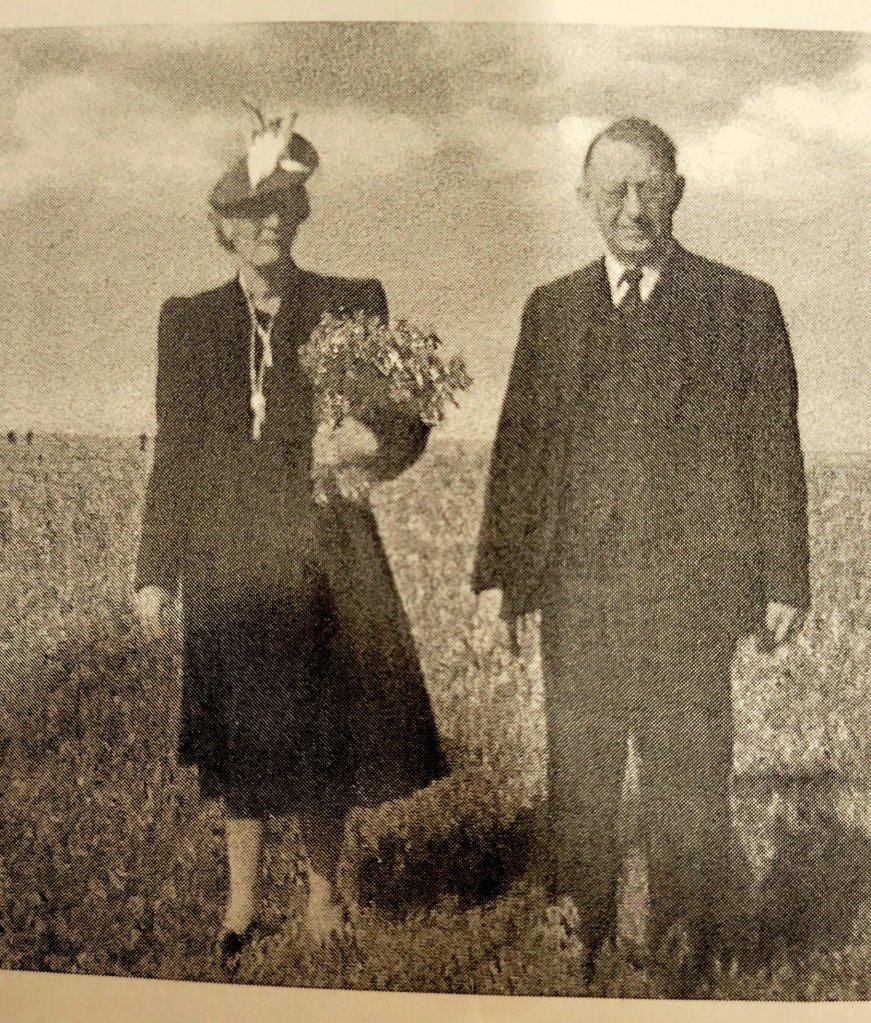
Parnell Swinson’s father, Peter, and two of his daughters.

Pete had a bad habit in those early years of being oblivious to the passage of time. One warm summer afternoon, he had gone fishing and the sky began to darken with the makings of a severe storm but Pete didn’t notice it until things began to happen…high wind, rain, and marble-sized hail. He started for home but didn’t reach it until it was almost over. He was drenched to the skin and covered with big welts where the hailstones had pelted him. He was surprised his family had been concerned about him, but he didn’t recall that this experience helped him to head for home earlier when the weather looked bad or when it began to get dark.

During the summer Pete’s mother often worked outside. Consequently, when he was small his older sisters did the housework and also took over the job of policing him. On several occasions when he disliked what he considered bossiness, he threatened to run away. Thelma, one of his sisters, was fed up with his threats and one day when he made known his intentions, she packed his clothes into a big suitcase, handed it to him, and told him goodbye. There he stood…a small boy of seven or eight with an oversized suitcase in his hand and he didn’t know where to go with it.

**When I was reading this part of Pete’s notes about his childhood, I had to laugh. I remember my dad (Bill) telling me about a time when he was probably 7 or 8 and his baby brother, Chuck, was bothering his mother. She made the comment that she would sell that baby for a nickel. Little Billy went to his room, got into his piggy bank, pulled out a nickel, and brought it to his mother. He said he wanted to buy baby Chuck. His mother did what Pete’s sister did. She packed up all of little Chuck’s things and took them to little Billy’s room. She took his nickel, and said baby Chuck was all his. Then she left to continue with her housework. It wasn’t very long at all until Billy came with Chuck’s things and Chuck himself. He asked his mother if he could please have his nickel back. It must have been a typical child-rearing method used back in those days to teach children to be careful what they wished for.

As Pete grew up, as was said, he wasn’t crazy about school. He would rather have been hunting, fishing, swimming, skiing, or tinkering with cars than sit in school. He got hold of a Model T chassis and by searching junk yards and abandoned cars, put together a whole car. He said it wasn’t too much to look at, but it ran. He spent many hours of his time rebuilding the car, but he felt it gave him some really valuable experience

Pete sitting on a different car

On the dairy farm they had very contented cows after he piped-in music to the barns. The music helped him, too, but he promised himself that when he grew up, he would never milk a cow again and he kept that promise.

After his dad broke his ankle and really wasn’t able to do much, Pete took over the milk route. He had very fond memories of those days. He got to know other families, and their dogs and cats. He also learned some of the family secrets when he walked into their houses unannounced to put milk into their ice boxes. He always liked music. I guess that’s probably why he piped music into the cow barn. One time he made a bargain with his sister, Pearle. He said he would teach her to drive a car if she would teach him to play the piano. One session in the car and one at the piano was as far as they got. She never did learn to drive a car and he never mastered the piano.

In high school, Pete played some basketball and 4 years of football. At one football game he was injured but was soon back in the game. He finished the game, looked around a bit, and then went home and chopped a pile of wood. That was really hearsay for it was about that time he came to. He couldn’t remember anything that happened after the injury. One member of his family insulted him by saying she knew something was wrong when he chopped the wood without being told.

Peter graduated from high school in 1935…

**It must be quite an experience to be the youngest of 7 children with 4 older sisters.

I know my friend, Sherri, adored her dad, as did her two sisters. I know Sherri has a fondness for fishing. Times have changed, though. Unlike Pearle, Sherri can also drive.

We’ll get to the later years of Pete Swinson’s life, but I will close this portion by saying that from everything I have heard and read about him, Mr. Swinson was quite a remarkable man…

Murdo Girl…Inside my Grandma’s trunk

When I was just a little girl, the stories I most loved to hear, were found inside my grandma’s trunk, filled with things from yesteryear.

I saw her in a picture. Not one hair was out of place. She wore a prim and proper dress made of satin adorned in lace.

Mary Tyrrell Sanderson

“Why aren’t you smiling, Grandma?” I asked her once again.

“My photograph was seldom taken. They were like portraits way back then. People struck a serious pose, stood tall, and calmly waited. A startling ‘poof’ and blinding flash confirmed their likeness was created.”

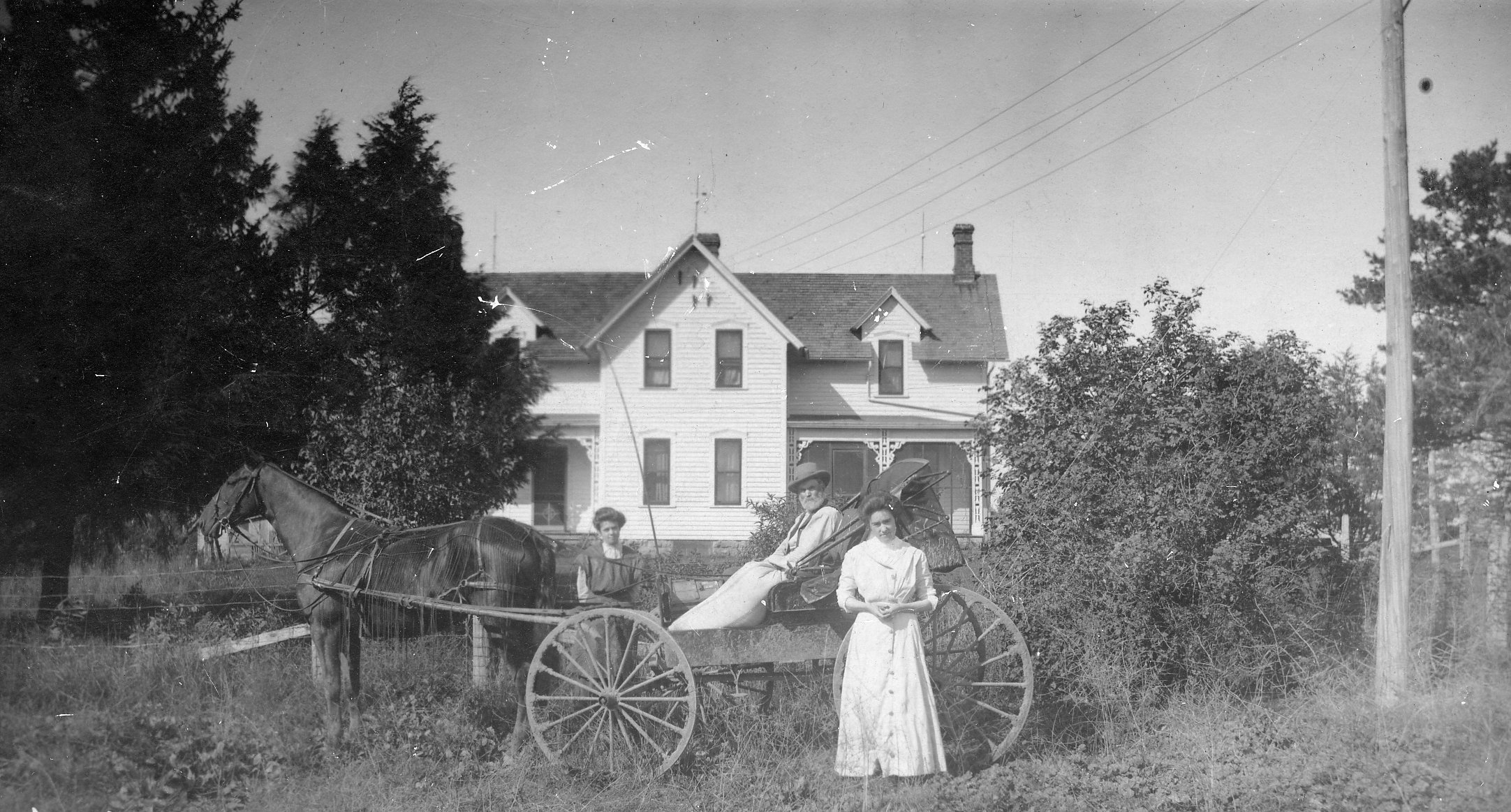
(Mary standing in front of her father in the buggy and her mother standing behind the wheel. Taken at the Tyrrell Farm.)

She reached inside the trunk and found an album bound in leather. Oh, the stories Grandma told when we looked at it together.

Time was captured in that book. Long ago came back to life, as Grandma told the story of becoming Grandpa’s wife.

“How did you and Grandpa meet?” Grandma knew I’d never tire, of the story beginning in the church, where she was singing in the choir.

Oxford Mills Methodist Episcopal Church where Grandma sang in the choir

Grandpa came with a lady friend, but Grandma caught his eye. He did some work on her father’s farm and came to know her by and by.

Maynard Evan Sanderson

They were married May eighteenth. Nineteen eleven was the year. They moved from Iowa to South Dakota. No other family would be near.

Two daughters and two sons were born… a new home they began to seek. They bought land and a log cabin in a pretty place called Horse Creek.
Horse Creek for a picnic many years later

The young Sanderson family before daughter Elna was born

They worked hard to make a living two more daughters soon arrived. Grandma said without their children’s help, they wouldn’t have survived.

Inside that big old trunk that had followed Grandma’s life, was a treasure trove of stories of happy times and times of strife.

When we finally closed the trunk, Grandma’s eyes began to shine. She said, “I could not be prouder of those six kids of mine.’

I heard a little cough. I turned around in time to see… Grandpa smile and wink at Grandma who was as pleased as she could be.
Murdo Girl…Horse Creek

I think this is a good time to write about Horse Creek where my mother’s family lived until she was eleven. I’ve written about it several times in the past, but this will include a description written by my mother’s older sister, Helen. My cousin, Bobby, who is Helen’s son, shared it with me.

My mother, Loretta, often talked about her horseback riding adventures, working outside with the boys in the family while the girls helped Grandma inside, and going to school with the thirteen Osborn kids.

Helen Sanderson Haverberg wrote the following…

Dad was excited about our first Model T. Ford but it was a worry for Mother for fear it wouldn’t last and we would have to go without so many other things. We had a Model A touring car later, which made the seven mile trip to Murdo much more pleasant. Two miles were on dirt and the other five were graveled.

My two younger sisters (Loretta and Elna) were born after moving there. The rural school was three and a half miles over hills and valleys. The school had a barn for horses, two outhouses, and a cistern for rain water. We always rode our horses although we were unhappy they went without food all day. There were twelve of us in the eight grades. Most of those were from the Osborn family which had thirteen children. As each of us started school, our big challenge was to remember the names of all the Osborn children. The older girls were motherly to the beginners.

The struggle by the Osborn family will explain the courage and determination needed at that time to survive. They lived in a three room frame house, heated by a wood-burning stove, but several of the boys had to sleep in the attic of an out-building. Several also stood at the table to eat. Mrs. Osborn made delicious bread and they each carried a sandwich to school made with “cocoa junk” between the slices. They mixed cocoa, sugar and whole milk together which soaked into the bread. We felt fortunate that we could have sardine sandwiches, our favorite for years and they were four cents per can. The larger came in mustard or tomato sauce and were also good.

I was never unhappy because our family pulled together and Dad was a strict disciplinarian. When things got too rough for Mother to handle, she would lower her voice and say, “I’ll have to tell Dad.”

Wayne, Mary, Ella, M.E., Loretta on her mother’s lap, Melvin (Jeff), and Helen on her father’s lap.
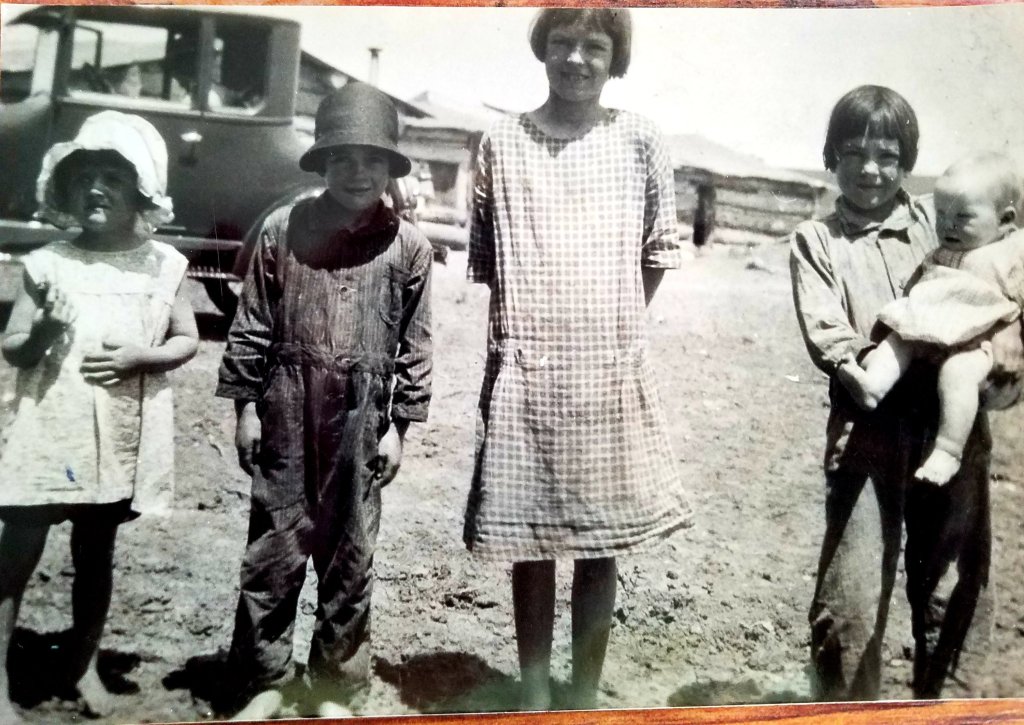
The little girl on the left might be an Osborn… Mom, (Loretta) in the overalls and hat, Ella, in the checkered dress, and Helen holding baby, Elna. They’re standing in front of the log cabin.

I would like to go on record as saying I’m pretty sure I would prefer cocoa junk over sardines…

Murdo Girl…The rhythm of life..a pioneer marriage

In their ranching career, E.W. and Lois McNinch considered themselves to be a self-supporting ranching unit, and they knew they could take care of themselves. In the throes of it all, it took both of them to resolve the problems at hand. E.W. is quoted as saying. “Harsh words were never involved in reaching a decision.”

E.W. considered himself to be a peculiar human being, and always had a word or two that he nursed along. The word “privilege” was one he referred to occassionally. He thought one of the biggest privileges of all was to be an American. He said the word “why” was an adverb. A Marine Sargeant told him one time that if an officer told him to do something, to go and do it and don’t ask why because there was no such word as why in the Marine Corps.

In twenty years, Lois and Elba had accumulated 3,200 acres of deeded land with water for irrigation and a herd of 450 of some of the best cattle in Sublette County. They had several tons of carryover hay each year.

Elba wrote, “The challenge we had faced was put to rest by the trust and faith we had in each other, and Lois added some prayers. We always knew we had given it our very best.”

Elba said when they looked over the past, their marriage seemed like a miracle to them both. They were able to commence each morning where they had left off the evening before. Their bank account was joint and their business papers included both of their names. Lois was complimented on her excellent bookkeeping and was always greeted with a smile at the bank.

**Kip and I visited his Grandpa McNinch at the ranch when he was well into his 90s. We asked if we could interview him. I think we asked one or two questions before he told us his story without our prompting him. I remember he had notes written on a yellow tablet. Whenever he mentioned “Mother” as he called his dear wife, he got tears in his eyes.

At the end of our visit, he said, “If our ranching career was to be lived over again, there would be very few changes. We were happy. What more could anyone ask for.”

Indeed..

There is a new book out called The Pioneer Marriage. It discusses three factors that made marriages work back then and could help some couples now. They are, 1) A commitment to grow, 2) Establish an effective communication system which includes respect, talking, and listening, and 3) The ability to make creative use of conflict. In other words, communicate without pushing each other’s buttons…learn about each other by using positives.

It seems to me that Lois and E W. McNinch could have written that book.

The rhythm of life weaves its threads and new generations are created from the hearts and souls of the families that came before us. On Memorial Day, remember those who served and those who pioneered this great country of ours. God bless them all…

Murdo Girl…The Rhythm of life….Fighting through hard times.

Peter M. Swinson was born in 1862 in Norway. He came to the United States in 1879 when he was 17. Rudolph Gustafson, was born in Sweden in 1893 and came to America in 1912 when he was 19.

E.M. (Gus) Gustafson, my 2nd father, explained that sometimes, such as in the case of his father, Rudolph, the family farm in Sweden, was not large enough to support a big family; therefore, some of men came to America. They were seeking the opportunity to establish themselves, and to raise and support their own families.

In some cases, the family was split from that point on and quite possibly never saw each other again.

The depression devastated yet another pioneer family. Grasshoppers, and drought brought about hard times with large financial losses on the farm and in the dairy business. It must have been a terrible blow. Shortly before the second world war came along, the Swinsons gave up the dairy farm and decided to try to salvage the ranch. They moved into a little house that I think was owned by a family member. Shortly after the move, which was in July of 1942, Peter M. Swinson died at home of cancer of the digestive tract. The insurance money was used to clear the ranch from the remaining debt.

The depression years…

Peter’s son, Parnell, described his father as being a temperate man in all things, nevertheless, one of his hobbies was making his own beer or as he called it “home brew.” It was made from water, malt, yeast, and sugar. After it had “brewed” for the right length of time, it was bottled and capped and put into crates which were stored in the basement. It was usually shared with visitors who often commented that some of the beer was rather potent. It is believed that somewhere in the basement under crates and boxes, there is some “home brew” Mr. Swinson made many decades ago.

As I have noted before, many of these pioneers I’m writing about weren’t what you would call big men. Mr. Swinson was only 5’8″ and weighted about 155 lbs. When he died at the age of 80, he had most of his teeth, and his thick black hair had not turned entirely gray.

Mr. Peter M. Swinson was mild mannered yet independent, resourceful. and determined. He believed that if a man worked hard and didn’t spend money foolishly, he would get ahead. He demonstrated this time and again in his own life.

Mr. Swinson died on December 11, 1942…a year after the United States entered the 2nd world war. His son, Parnell, enlisted in the Navy on December 8, 1941. The day after Pearl Harbor was bombed.

Once again, I’m awed by the courage and perseverance, Mr. Swinson, Mr. McNinch, and Mr. Francis showed as they built their ranches, farms, and businesses. Later, I will be writing about Rudolph Gustafson who immigrated from Sweden.

Old Highway 16 goes through Murdo and Presho, SD

Peter Swinson, Jack Francis, and Rudolph Gustafson all lived in and around Presho, SD at one time in their lives. The population of Presho in the forties was around 500 and if everyone is home, the count would be slightly under 500, today.

Woven threads of color,

A beauty to behold;

Each thread a chapter of a life.

The tapestry unfolds.

There within the richness,

Are tears of golden hue;

While silver threads of laughter,

Are gently woven through.

Hanging there in splendor for all the world to see;

The beauty of a life well spent, in richest tapestry.

Anonymous

Murdo Girl…Touching up the Cottage

I decided this would be the perfect day to make the cottage a little springier. I began by staining the beautiful wood walkway that Kip built. I was almost finished when a humongous gust of wind came through. It picked up the pan of paint and threw it into my face. Can you believe it? Kip was convinced that my new glasses were ruined. “It will eat the plastic,” he said.

I ran into the house and immediately   cleaned my glasses, which were fine. I wish he would have been as concerned about my painted hair. I could not get the paint, that was holding huge chuncks of my hair hostage, to break free. I read online that toothpaste would work…it didn’t, plus I mistakenly chose a whitening toothpaste. I’m pretty sure the paint covered hair has lightened up again. Remember my highlighting fiasco? I just got the yellow calmed down.

Taken before I highlighted or painted my hair...

Anyway, I’m going to sleep on it and see what further steps I need to take in the morning.

After
After…
I’ve decided to paint the posts brown…and then decorate with spring/summer colors. Maybe LJ will have some ideas.

I will soon get back to the stories about the Swinsons, McNinches, Francises, Gustafsons, and Sandersons. There is so much more to tell…

Happy Mother’s Day to all the women out there who have had a hand in raising kids…it takes a village.

I was almost frustrated enough to get the scissors out and cut off the mess, when a little bit of common sense returned, which is surprising. I’m going to see my grandson graduate next week and I have already far exceeded my usual before trip weight gain, so I didn’t want to go with 2″ long hair.

It’s all about the rhythm of life. We aren’t clones of those I write about, but there is no mistaking the genes and family history along with our higher power, predetermine who we are or at least greatly influence who we become.

Murdo Girl…Happy Birthday Mom

My cousin, Bobby, sent me a piece his mother, Helen, had written about growing up in Horse Creek. It is really a stand alone piece, so I’ve decided to include it with my Rhythm of Life stories. In the meantime, I want to wish my mother, Loretta, a heavenly happy birthday….

One 101 years ago someone special did arrive.

They thought she’d be the last child born as she was number five.

Her father called her Babe, then another joined the mix.

Six years later came a big surprise… baby number six.

She went to country school where the kids sat side by side.

 She told me when she moved to town not one classmate cried.

To skip part of this story you’ll agree won’t be a crime.

To cover all 101 years would take all of your  time.

Though her personality can’t be easily defined,

This woman whom I’m speaking of was truly one of a kind.

From bold and beautiful to successful entrepreneur.

She was courageous and confident and not at all demure.

Mischievous, sometimes cantankerous, horse race enthusiast,

She was the hootiest. 

Her two offspring and her husband, Gus, still miss her every day,

And we’re remembering her today…her May the 6th birthday

1-Loretta Gustafson's Life in Photos 017-001

Murdo Girl…The rhythm of life..The Murdo Depot

I’m going to tell a little bit more of the Francis side of my family’s story. Not only is it interesting, but it tells you a little bit more about my dad’s youth. I intend to write about one of Peter Swinson’s sons, Parnell, and about Jack Francis’ son, William or Bill. I’m also going to write about my 2nd father, Gus’ family. His father came over from Sweden in 1893 when he was only 19 years old.

Connie and Bill Bowers

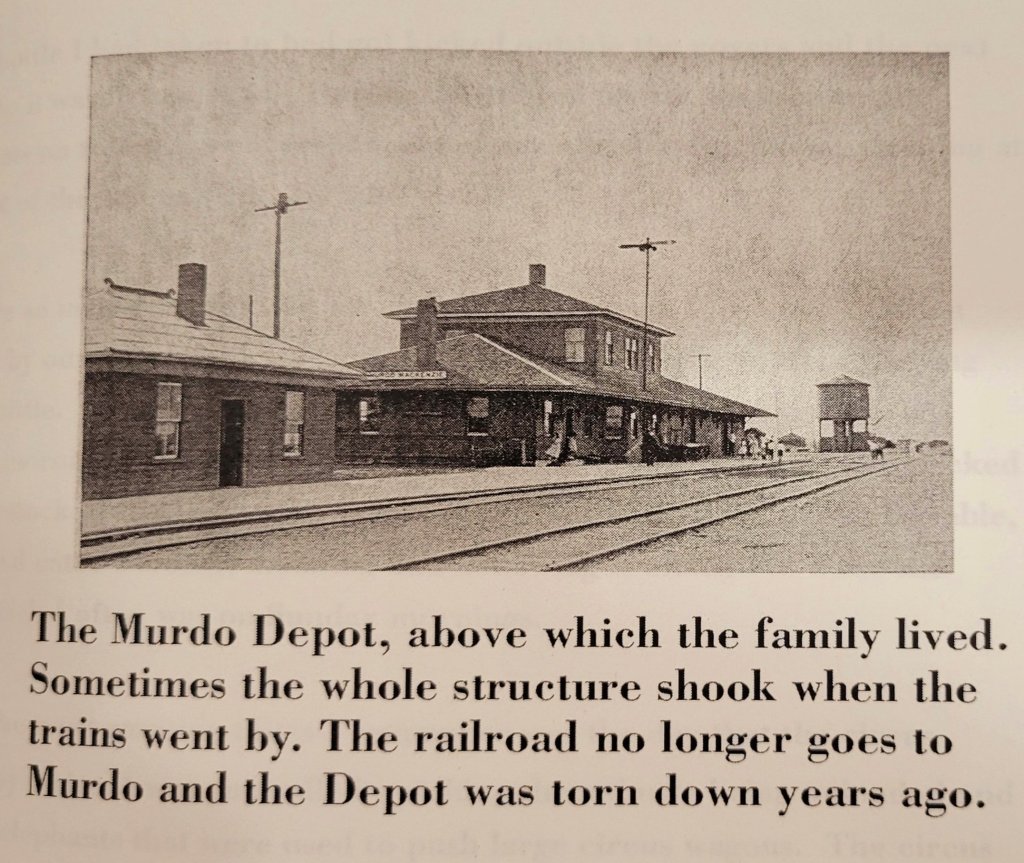
After Jack Francis died in 1926, Connie continued to run the the stores. In 1928, she married William Bowers who was 17 years her senior. He was the Murdo agent for the Chicago, Milwaukee, St. Paul and Pacific railroad. Connie and her boys moved in with Mr. Bowers who lived with his three children in rooms above the depot. The ages of the children were 2, 8, 12, 15, 17, and 20. The only girl was Margarete Bowers who was 15.

The marriage by all accounts was a very successful and devoted union. Connie’s boys called their step-father, Dad Bowers. The couple were never heard arguing (loudly anyway) and all got along well considering they lived in very cramped quarters. I remember Dad saying that his mother would dust the house and then a train would go through and there would be coal dust to deal with, again.

Connie kept the Murdo Hardware store until after the war. She then sold it to Nick Thune. Nick had moved his family from Mitchell, SD to manage the store in 1930. He was a Norwegian immigrant. He and his wife, Maude became very close friends of the Francis family.

When Nick assumed ownership, the store’s name was changed to Thune Hardware. It was later operated for several years by Nick’s sons, Harold and Gilbert. Harold earned Most Valuable Player honors on the University of Minnesota basketball team and was a decorated Navy pilot in the Pacific during WWII. He went to high school with my dad and he was my Algebra teacher.

Harold Thune recalled that Grandma Connie provided young Bill, with a 12 guage shotgun for hunting when all the rest of the gang could only afford BB guns. He also remembered that Bill went on to become almost fabled for his marksmanship.

The depression of the thirties hit Murdo, SD like it did everywhere else. People had very little money for the essentials. They would steal coal from the railroad coal cars parked on rail sidings near the station to refuel the engines. The farmers faced, drought, grasshoppers, and low grain prices.

A man who worked for the railroad as a brakeman got his right arm caught in a coupling between two railroad cars. They had to amputate his arm which of course put an end to his ability to earn a living on the railroad. He probably got a small pittance, but it wouldn’t have been enough to support his rather large family. He soon decided to start a grocery store in their home. Many farmers brought eggs, butter, cream, and other products in exchange for groceries. The store operated for many years. I recall going there when I was a small child. If I remember correctly, it was in the middle of a neighborhood a few blocks over from Main Street.

As in other towns hit with the depression, there are examples of people taking care of each other. When a child’s family couldn’t afford to buy glasses for their son, the school superintendent purchased them. The boy eventually went to the School of Mines in Rapid City, and became an executive with General Electric.

After Dad Bowers died in 1943, Connie moved to California. She was excited about keeping house for her son, Chuck, and his to friends who were enrolled at UCLA. It was 1947.

She said she wanted to go back to Murdo for a visit and she wanted to have a physician examine her before going. The doctor discovered she had breast cancer. The cancer spread to her lungs and she died on April 1, 1948. She was 59 years old.

The threads of family continue to weave through my life. Though I never met my Grandma Connie, I feel like I know her. I have heard my father talk about her, and he often sang the songs she taught him. He talked about her great wit and sense of humor. He and his friend, Dan Parish, once told her she had to make an angel food cake for a school function. She later discovered she had made an angel food cake for a couple of devils.

Connie was dearly loved by all six of the Francis/Bowers kids who lived together above the Murdo train station.

I’m very proud to be her granddaughter…

Murdo Girl…He stepped up

The moniker, “step-father” makes me think of Cinderella.

She had a wicked step-mother…

Who wouldn’t let her find a fella.

She had mean and simpering step-sisters…

They said she was a freak.

Poor Cinderella had to think her future would be bleak.

Then along came a fairy-god-mother…

A magic wand was her trademark.

Cinderella went to the ball…

And knocked the Prince out of the park.

For step-mom and step-sisters…

It didn’t end too well.

They couldn’t get the Prince from under Cinderella’s spell.

Some think happy ever after…

Is only in fairy tales.

Some think it can be found…

After everything else fails.

*****

When you married my mother, I didn’t know you very well.

I hoped you’d make her happy. Only time would tell.

You not only gave her love…

You gave her so much more.

You were the same good man each day…

As you were the day before.

Forty-six years ago you and Mom were wed.

When asked about my brother and me…

This is what you’ve always said,

“He’s my son and she’s my daughter.” (You don’t say that you’re too young.)

You were fourteen when Bill was born. I was born when you were twenty-one.

Our family is pretty big now. To our kids you’re Grandpa Gus.

When you married our Mom…

We got the best for all of us.

wp-image-3418630029616159564jpg.jpg
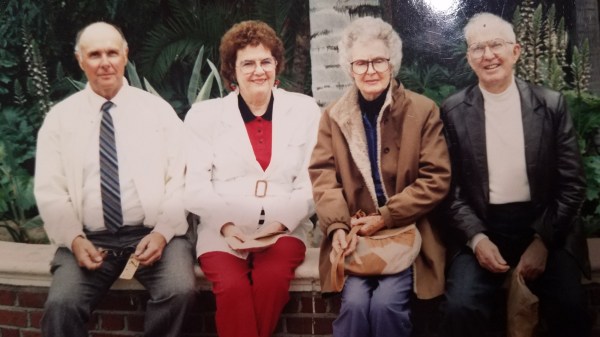
Gus, Mom, Mom’s sister, Ella Leckey, and brother, Jeff Sanderson

**********************

After all these years, step-father could be something I might say,

Because when friends or family need you…You’re only a step away.

And when you need your son or daughter, we hope you’ll always know…

We’ll step up just like you have… since all those years ago.

Gus’ 90th birthday is the 30th of May. We’ll be celebraring him all month